We arrived in Halifax, Nova Scotia. Met our fellow Earthwatch volunteers at the airport and waited to be picked up. After a 2-hour ride to our house in Cherry Hill, we ate dinner and got to know one another a little better.
Our Expedition Team
- Drs. Christina Buesching and Chris Newman—Principal Investigators, University of Oxford
- Jennifer Griffith—2nd Grade Teacher, Chicago, IL
- Amy Andrews—3rd Grade Teacher, Chicago, IL
- Bob Minoff—5th Grade Teacher, Long Island, NY
- Sharon Avis—Bank Compliance Manager, England, U.K.
- Carole Bradley—Retired Music Teacher, Richmond, VA

- Elaine Clubley—OR Technician, England, U.K.
- Lyman Davenport—Radiologist, Providence, RI
- Karen Elder—Telephone Co. Compliance Manager, England, U.K.
- Catherine Harkness—Physician, England, U.K.
- Cheryl Liddiard—Midwife, England, U.K.
- Jane O’Shaughnessy—Civil Servant, Ireland, U.K.
- Joan McBain—Retired, Hartford, CT
- Lycos—Chris & Christina’s dog and team mascot

This morning, we had an introductory talk about Mammal Monitoring Science by Dr. Chris Newman. He informed us of the research that has taken place in Wytham Woods, England for the past 20 years. We learned about why it is important to monitor mammals* and characteristics of mammals*. He went over the list of animals that we will be looking for at Cook’s Lake beginning tomorrow:
- shrews (3 types), mice (2 types), voles (2 types), porcupines, chipmunks, bog lemmings, deer moose, snakes (4 types), skunks, bobcats, marmots, showshoe hares, owls, woodpeckers, eagles, beavers, otters, badgers
- “Scat” that we saw today--porcupine, muscrat, otter, deer, and raccoon
- Tracks that we saw today--bobcat, deer, and raccoon.
- Animals that we saw today--deer, a worm snake, and harbor seals (look and listen to the video below)
Day 3—Monday, October 1, 2007
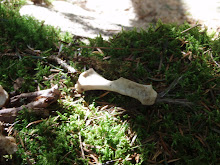
Today we went to Cook’s Lake and learned about the history of the land from Christina. She took us on a tour of the area and showed us many interesting field signs, such as a porcupine latrine (full of porcupine “scat”) and the remnants of a porcupine that had been killed by a fisher. Nearby, we saw porcupine tracks and scratch marks on a tree.
The BIG find of the day were fresh black bear tracks! Christina pointed out that the varied paw and footprints meant that there were 2 different bears, most likely a mother and a cub. Tomorrow we will set camera traps and hope to get some video of them!
This afternoon, we set our small mammal traps (100 of them!) and split up into 5 teams to place them systematically into the area of the “grassland” that has been set aside for our team. Amy, Bob, and I set our 20 traps and hoped for the best!
Day 4—Tuesday, October 2, 2007
We were so excited to check our traps this morning……at breakfast, I took bets on which team would have the most closed traps and how many total living mammals we would have as a team. Our team (Team E) was very proud to have 4 of the 16 total traps that had closed doors (meaning something was inside—at least we hoped!)
Christina taught us how to safely check the trap, “scruff” the vole, shrew, lemming, or whatever we might have caught, and then we were each able to take a turn. In all, we had 11 live mammals (and one dead shrew L). We learned how to “clip” the mammal (cut a small section of the guard hair in order to mark it in case of recapture) and then returned the live animals back to their exact spot of capture.
After resetting the traps, we went on a “Scat hunt” (literally looking for poop!) I have to say that I was VERY good at it and found the most of the group—I was awarded an honorary “Poo H.D.”
Why look for “scat”?
1. It is evidence that an animal has been there which helps us monitor that animal’s population
- For example, too many deer can destroy a particular habitat for other animals—eating too much vegetation can deplete the protective covering
 and food source for meadow voles, mice, shrews, squirrels, etc. and make it difficult for plants to regenerate

- It tells what the animal has been eating
- Shows where the animals live since “scat” marks an animal’s territory
- Helps us identify and monitor diseases (such as the brainworm in deer), DNA, and hormones in animals
Day 5--Wednesday, Oct. 3, 2007
We checked our traps again today and found 5 traps with doors closed. When we emptied them, we had caught 4 meadow voles (one sneaky critter had escaped through the "shrew hole!) After lunch, the team divided into 2 groups and worked on helping clear new paths for Cook's Lake.

Day 6--Thursday, Oct. 4, 2007
After our last check, we brought in all of the traps (they weren't that easy to find!) and counted up how many animals we monitored over the 3 days.
Out of 100 traps set, we caught:
- Day 1—11 live mammals
- Day 2—14 live mammals
- Day 3—17 live mammals
After lunch, we went to the nearby town of Liverpool to take in some sights, do laundry and use the internet!